
You notice round bumps or soft spots on asphalt and want to know what they are and how risky they might be. We can quickly tell you that surface bubbles and blisters are signs of trapped moisture, poor compaction, or improper mix or paving conditions, and they need prompt diagnosis to avoid wider damage. This article shows how to spot true blisters, what causes them, and which fixes work best.
We will walk through the common causes, simple diagnostic steps you can use onsite, and practical prevention and repair options. By the end, you’ll know when a problem is cosmetic and when it needs professional attention.
Understanding Surface Bubbles and Blisters in Asphalt
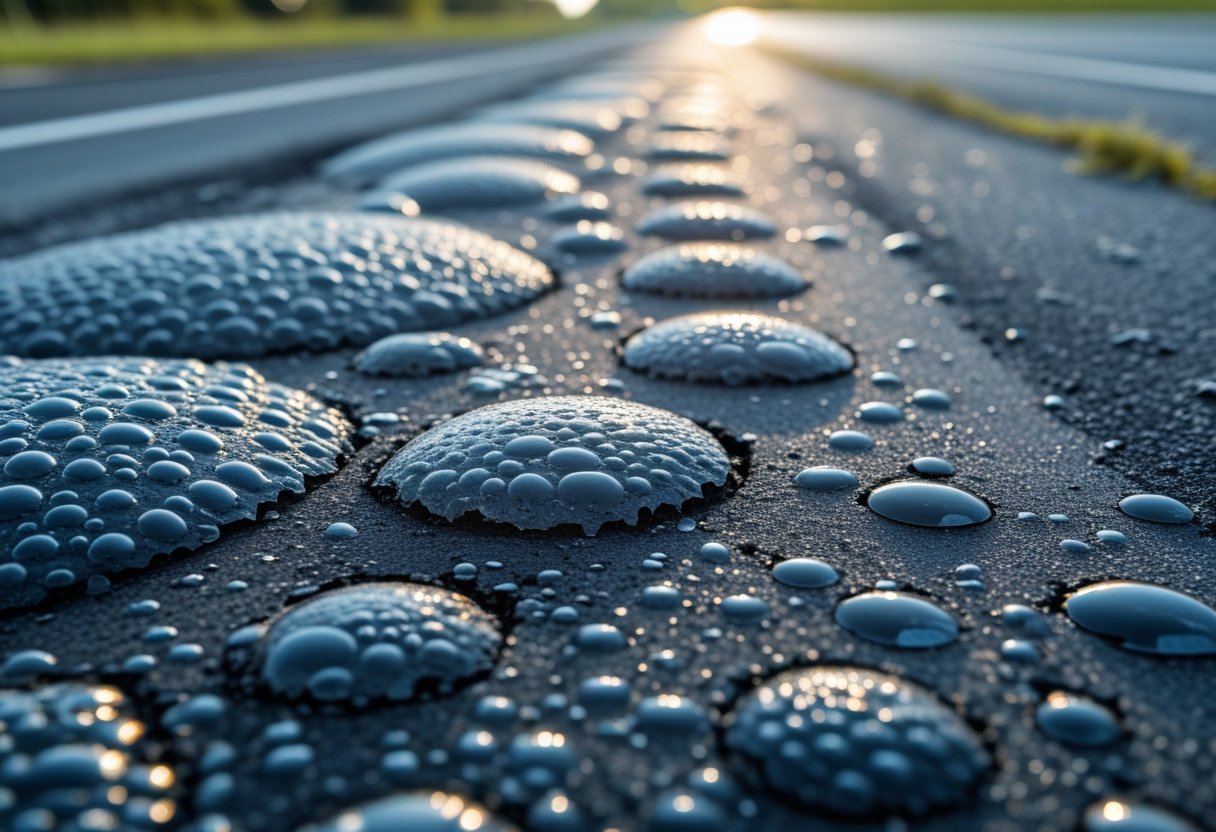
We describe how bubbles, blisters, and peeling fractures form on asphalt pavements, how they change surface flatness, and why they matter for pavement integrity. This helps us identify causes, spot signs, and decide repairs.
Defining Surface Bubbles and Blisters
Surface bubbles and blisters are local lifts of the asphalt surface caused by trapped air, moisture, or volatiles under a thin layer of binder or mix. We see them as rounded, raised areas that break the smoothness of the asphalt pavement.
They range from a few millimeters to several centimeters across. Smaller bubbles sit on the surface; larger blisters may reach deeper layers and show cracking or loss of material. We check texture and edges: a soft, springy center often means trapped moisture; a hard, delaminated edge suggests bonding failure.
Common causes include hot mix gases, steam from moisture in the base, poor compaction, and incomplete binder curing. We inspect nearby drainage and construction records to find likely causes.
Common Types: Bulges, Blistering, and Peeling Fracture
Bulges are broad, dome-like rises caused by trapped gases or subsurface heave. They usually affect surface flatness and give a visible hump. We measure height and width to judge severity and risk of cracking.
Blistering of asphalt pavements shows as circular, shallow bubbles with intact surface skin. They form when steam or trapped volatiles expand during paving or heating. Blisters often occur near seams or over less compacted spots.
Peeling fracture happens when the surface layer detaches and peels away. It appears as jagged edges or flaking and indicates poor adhesion between layers. We treat peeling fracture as a structural issue because it exposes the underlying layers to water and traffic damage.
Effects on Surface Flatness and Pavement Integrity
Bubbles and blisters raise surface roughness and change flatness, creating ride quality and drainage problems. Even small blisters cause noise, vibration, and local ponding that stress the pavement.
They reduce surface integrity by allowing water and oxygen to enter deeper layers. This speeds fatigue and leads to more severe pavement distress like cracking and potholes. We monitor blistered areas because repeated traffic loading will enlarge defects.
Poor surface flatness also shortens service life by concentrating loads on small spots. We prioritize repairs where blisters or peeling fracture align with wheel paths or near joints to prevent rapid deterioration.
Key Mechanisms and Causes of Blistering
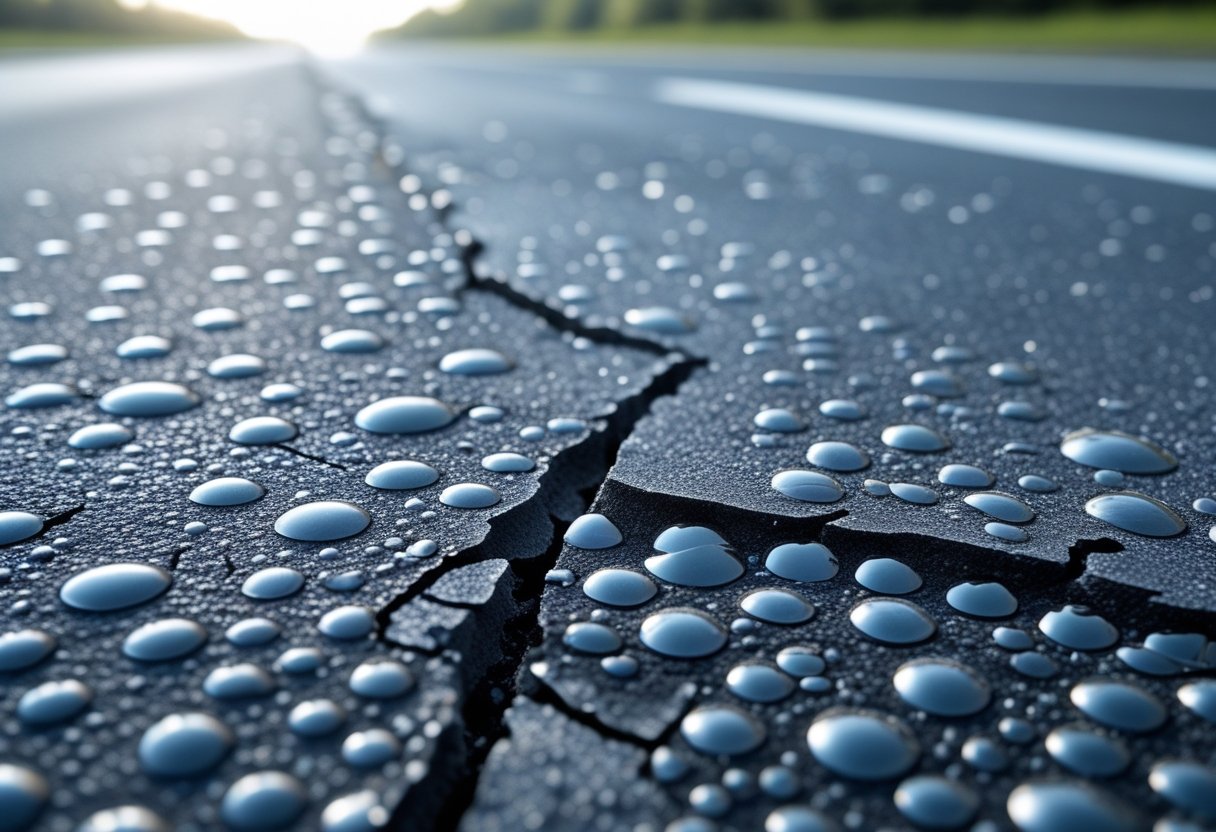
We identify four main causes that create trapped pressure, weaken bonds, or change asphalt volume. Each cause explains how heat, water, material mix, and chemistry produce surface bubbles and blisters.
Role of Temperature, Solar Radiation, and Thermal Fluctuations
We see asphalt heat up quickly under direct solar radiation, especially in hot climates. Asphalt temperature can spike above ambient air temperature, heating binder and trapped air in voids.
Rapid heating causes thermal expansion of binder and entrained air. That expansion raises inside overpressure in pavement voids and causes primary blistering when pressure exceeds adhesive strength.
Cyclic thermal stresses from day-night temperature fluctuation produce repeated expansion and contraction. Over many cycles, thermal buckling and fatigue reduce bond strength at layer interfaces, causing secondary blistering.
Areas with poor compaction or high air void content amplify the effect because more voids mean more trapped air and higher inside pressure during heat pulses.
Moisture Intrusion and Water Permeability
We find moisture intrusion through cracks, joints, or porous asphalt allows water into internal voids. Water permeability varies with mix and compaction; higher permeability lets more water penetrate.
When water trapped in voids heats, it turns to steam or expands, causing thermal overpressure that lifts the surface layer.
Freeze-thaw cycles also force water to expand and contract, widening voids and weakening aggregate-binder contact. That increases volumetric expansion potential and speeds blister growth.
Wet sublayers or a high void content close to the surface create pathways for vapor to collect. Where permeability is uneven, localized pockets of pressure form and cause isolated blisters.
Material Properties and Volumetric Expansion
We examine how mix design and compaction control volumetric expansion. High air voids and poor compaction let the asphalt mix expand when heated.
Thermal expansion of binder and aggregate mismatch (different coefficients) creates internal stresses. If binder softens at high asphalt temperature, it cannot restrain expansion, so surfaces bulge.
Dense mixes with low voids resist blistering better, while open-graded mixes tend to trap water and air. Additives, polymer-modified binders, and aggregate type change thermal-mechanical properties.
In hot climates, repeated thermal loading increases plastic deformation and can create buckling planes that allow blisters to form under surface layers.
Chemical Reactions and Loss of Adhesion
We focus on reactions that weaken the bond between binder and aggregate. Oxidation and aging make binder stiffer and more brittle, reducing adhesion and increasing the chance of delamination.
Chemical interaction with moisture (stripping) removes binder from aggregate surfaces, lowering adhesive strength and enabling layers to peel up as blisters.
Volatile compounds in the binder can vaporize under high asphalt temperature, adding to internal pressure. Combined with weakened adhesion from aging or stripping, even moderate pressure can produce surface blisters.
Contaminants like dust, oil, or anti-icing salts also reduce bond strength and raise the risk of blister formation when thermal or moisture stresses occur.
Diagnostic Techniques and Identifying Blister Formation
We focus on practical tools and observations that reveal why blisters form and where they hide. Our goal is to locate voids, trapped moisture, or thermal issues quickly so we can decide on a fix such as localized repair or an asphalt overlay.
Visual Inspection and Surface Assessment
We start with a close visual walkover of the pavement. Look for circular or elongated raised areas, cracking patterns, and changes in surface roughness or pavement smoothness. Measure blister diameter, spacing, and whether the material is pliable or brittle.
We record surface defects with photos and notes tied to GPS locations. Mark high-risk areas near joints, overlay seams, or drainage low spots. Use a straightedge or profilograph for quick checks of surface flatness and rutting that may hide subsurface problems.
Use of Ground Penetrating Radar and Machine Vision Systems
We use ground penetrating radar (GPR) to map layering and find subsurface voids under blisters. GPR shows contrasts between asphalt, aggregate base, and air pockets. Scan at regular intervals and compare signal amplitudes to detect anomalies.
We pair GPR with a machine vision system for rapid surface mapping. Cameras can quantify texture, color changes, and surface temperature patterns when combined with IR imaging. Integrating GPR data with machine vision helps us link surface irregularities to subsurface features.
Detection of Subsurface Voids and Moisture
We confirm GPR anomalies with targeted coring or small excavations. Cores reveal trapped air, delamination, or moisture that GPR suggests. Take moisture readings from cores and adjacent material to map the wet zone.
We use moisture meters and resistivity probes to profile damp areas under the asphalt. Persistent moisture indicates poor drainage, bleeding, or a failed bond that causes blisters. Document depth, width, and moisture content to choose repairs and to decide if a full asphalt overlay is appropriate.
Assessment of Surface Temperature and Traffic Loads
We monitor surface temperature with IR thermography during and after paving to detect thermal differentials that create trapped steam or soft spots. Rapid cooling zones can indicate thin overlay over a cooler layer, raising blister risk.
We analyze traffic loads and patterns in blistered zones. Heavy, concentrated traffic increases shear under weakened layers and accelerates blister growth. Combine load data with pavement smoothness and roughness metrics to predict areas needing reinforcement or a different overlay strategy.
Prevention and Remediation Strategies
We prioritize fixing the causes of bubbles and blisters by changing the mix, improving how we build pavements, keeping water away, and using targeted repairs or overlays. Each step focuses on practical actions we can take on materials, construction, and maintenance.
Improving Mix Design and Aggregate Properties
We select aggregate with low absorption and sharp grading to reduce trapped air and moisture. Using stable gradation helps interlock particles and lowers hydraulic conductivity in the granular layers beneath the binder layer. We avoid unsuitable aggregates that swell or break down under load.
We adjust asphalt mix and binder stiffness to match climate and traffic. For hot climates we use binders with higher softening point; for cold climates we choose mixes with better flexibility. We control asphalt content tightly to prevent overly rich mixes that trap volatiles and cause bubbles.
We add additives like anti-stripping agents and polymers when needed. These improve aggregate-binder adhesion and increase resistance to water infiltration. We test mix characteristics in the lab for durability, compaction effort, and moisture susceptibility before field placement.
Optimizing Construction Procedures and Compaction
We train crews on temperature control for the asphalt mix from plant to paver. Maintaining paving and compaction temperatures prevents excessive binder aging or steam formation that creates blisters. We monitor wind and surface temps and delay paving if conditions risk rapid cooling or moisture presence.
We use proper roller patterns and equipment to reach target density across the layer. Achieving uniform compaction reduces voids where steam or trapped air can form bubbles. We measure density in the field and adjust rolling patterns or number of passes as needed.
We ensure proper tack coat application and clean surfaces before overlaying. Tack contamination or trapped water between layers often leads to blisters. We schedule compaction so the underlying layer has cooled enough to accept the next lift without trapping heat or vapors.
Enhancing Drainage and Moisture Control
We design and maintain surface and subsurface drainage to limit water infiltration into asphalt mixtures. Slopes, edge drains, and longitudinal drains reduce standing water that weakens the binder layer. We check inlets and outlets regularly for clogging.
We place and compact granular layers to provide consistent hydraulic conductivity below the asphalt. Properly graded base and subbase let water escape and reduce pore pressure that pushes up blisters. We repair ruts and potholes that channel water into the pavement structure.
We seal cracks and joints promptly to stop water getting into the pavement. Crack sealing and localized drainage fixes are low-cost measures that prevent deeper moisture damage. We use compatible sealants and ensure good adhesion to the asphalt surface.
Maintenance, Repair, and Overlay Solutions
We inspect pavements frequently and map early signs of bubbles or soft spots to plan repairs. For small blisters we cut out the affected area and replace with properly compacted mix, matching the binder and aggregate properties to the existing pavement.
For larger or widespread blisters caused by trapped moisture or poor mix design, we mill the top lift to remove the problematic layer. We then correct the mix design or drainage deficiencies before paving an asphalt overlay. Overlays must use correct tack, temperature control, and compaction to avoid repeating the issue.
We use targeted treatments like infrared reheating for minor lifts or full-depth patching for areas with structural problems. We document the repair method, mix used, and compaction data so we can adjust future construction procedures and mix design to prevent recurrence.