
You want clear ways to spot and judge edge cracking so you can fix it before costs rise. We explain how edge cracks form, which factors make them worse, and what tests give reliable, on-site answers. This helps you prioritize repairs and extend pavement life.
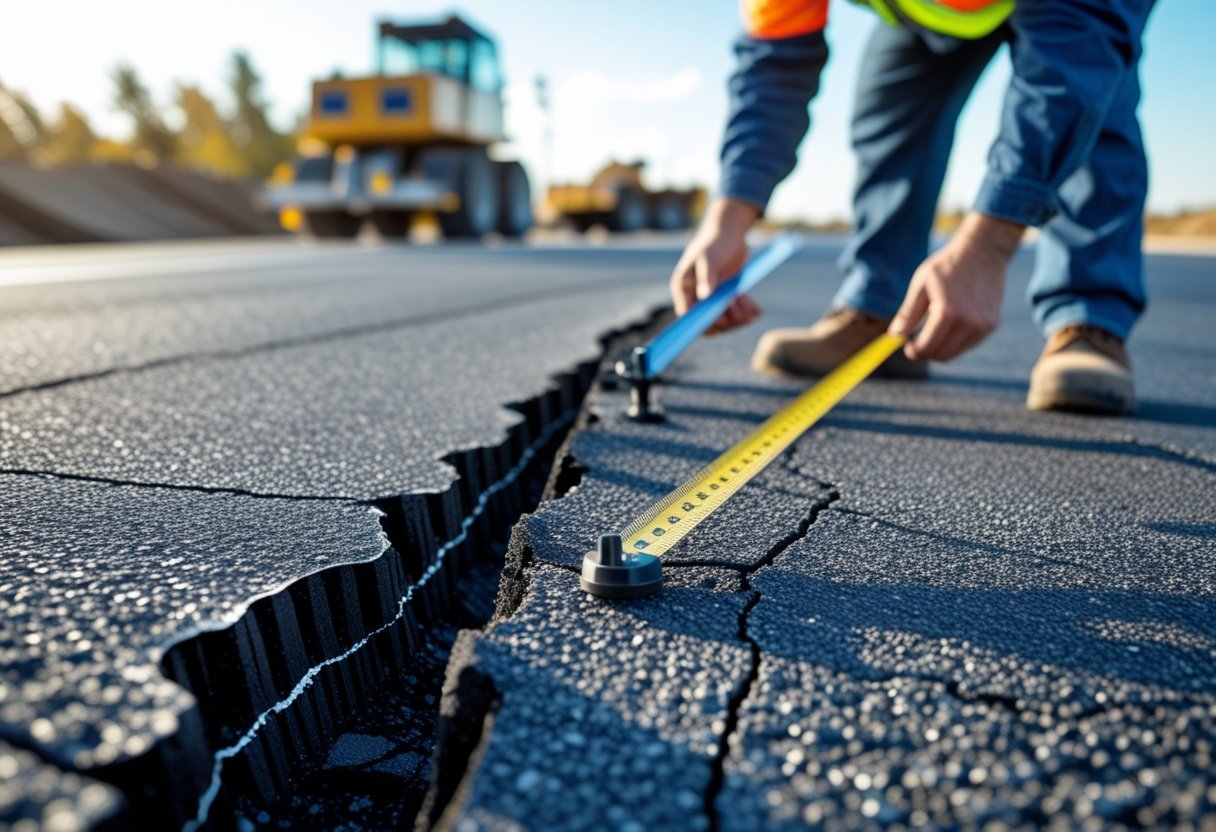
We walk through the science of cracks, the common causes like drainage and load, and practical inspection methods you can use right away. You’ll also see prevention and maintenance steps that save money and reduce future damage.
Fundamentals of Edge Cracking in Asphalt Layers
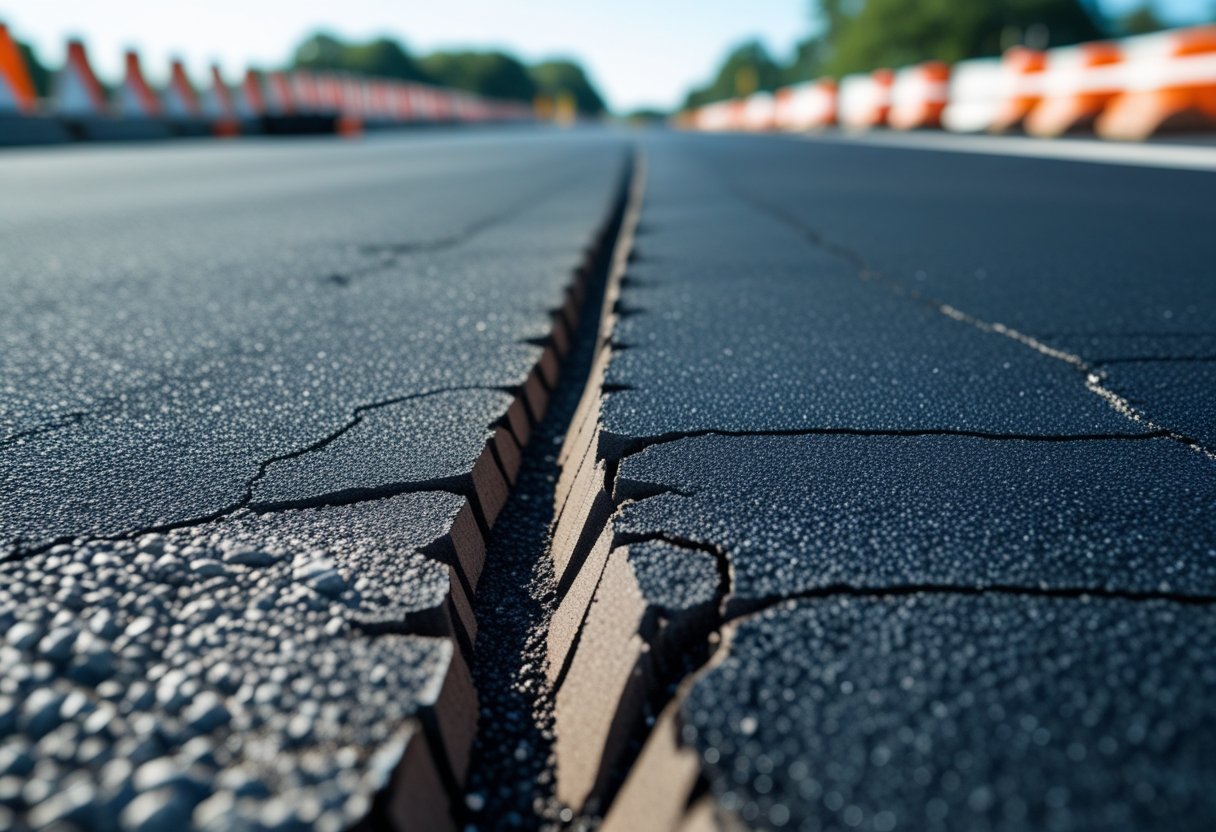
We explain what causes edge cracking, how it starts, and how it moves through pavement layers. We focus on the crack types, initiation mechanisms, and visible patterns that affect maintenance decisions.
Types of Cracking in Asphalt Pavements
We identify common crack types so we can link condition to cause.
- Edge cracking: Runs parallel to the outer wheel path near the pavement edge. Often starts within 0.5-1.5 m of the edge.
- Longitudinal cracks: Follow pavement length. They can occur at joints, lane lines, or along the pavement edge and often connect with edge cracks.
- Transverse cracking: Crosses the pavement width and can intersect edge cracks, creating complex failures.
- Block cracking: Large rectangular patterns from thermal shrinkage and aging. These rarely begin at the edge but can propagate to it.
- Fatigue cracking (alligator cracking): Network of interconnected cracks from repeated loading. Fatigue often originates near the edge where support is weak.
We note that edge cracking frequently coexists with longitudinal and fatigue cracking. A visible edge crack may signal deeper issues in the pavement structure, like weakened base support or poor shoulder detail.
Mechanisms of Edge Crack Initiation
We describe how physical forces and material conditions start edge cracks.
- Lack of lateral support: Soft or unpaved shoulders let the pavement edge deflect more under traffic. Repeated bending creates tensile strain at the bottom of the asphalt layer and initiates cracks.
- Traffic loading: Heavy axle loads near the edge concentrate stress. Single-wheel and tandem-wheel loads cause higher strains at the edge than in the pavement center.
- Material aging and oxidation: Stiffer, brittle asphalt binds are less able to stretch. Aging reduces fatigue life and raises the chance that edge-initiated strains produce cracks.
- Poor construction details: Inadequate compaction at the edge, improper joint construction, or a missing wedge shoulder lead to stress risers where cracks start.
- Drainage issues: Water infiltration weakens base and subgrade, increasing deflection and promoting crack initiation.
We emphasize that initiation usually involves a mix of these mechanisms, not a single cause.
Progression and Patterns of Edge Cracking
We explain how edge cracks grow and interact with other distress types.
- Early stage: Small, single-line longitudinal cracks form near the edge. They are narrow but appear after repeated loads or a severe weather cycle.
- Intermediate stage: Cracks widen and deepen. They link with longitudinal and transverse cracks, forming blocks or fatigue networks. Surface raveling and small potholes may begin along the crack.
- Advanced stage: Cracks propagate into the pavement, causing alligator cracking and potholes. Pavement structure shows loss of support under the edge, and patching becomes frequent.
We list observable signs that tell us progression rate.
- Crack width growth (mm per year), presence of patching, shoulder condition, and frequency of water pooling indicate speed.
- Patterns matter: parallel longitudinal cracks near wheel paths point to traffic-induced edge cracking; intersecting transverse lines suggest combined thermal and load effects.
We recommend tracking crack spacing, width, and connectivity to predict when structural repairs are needed.
Key Factors Influencing Edge Cracking
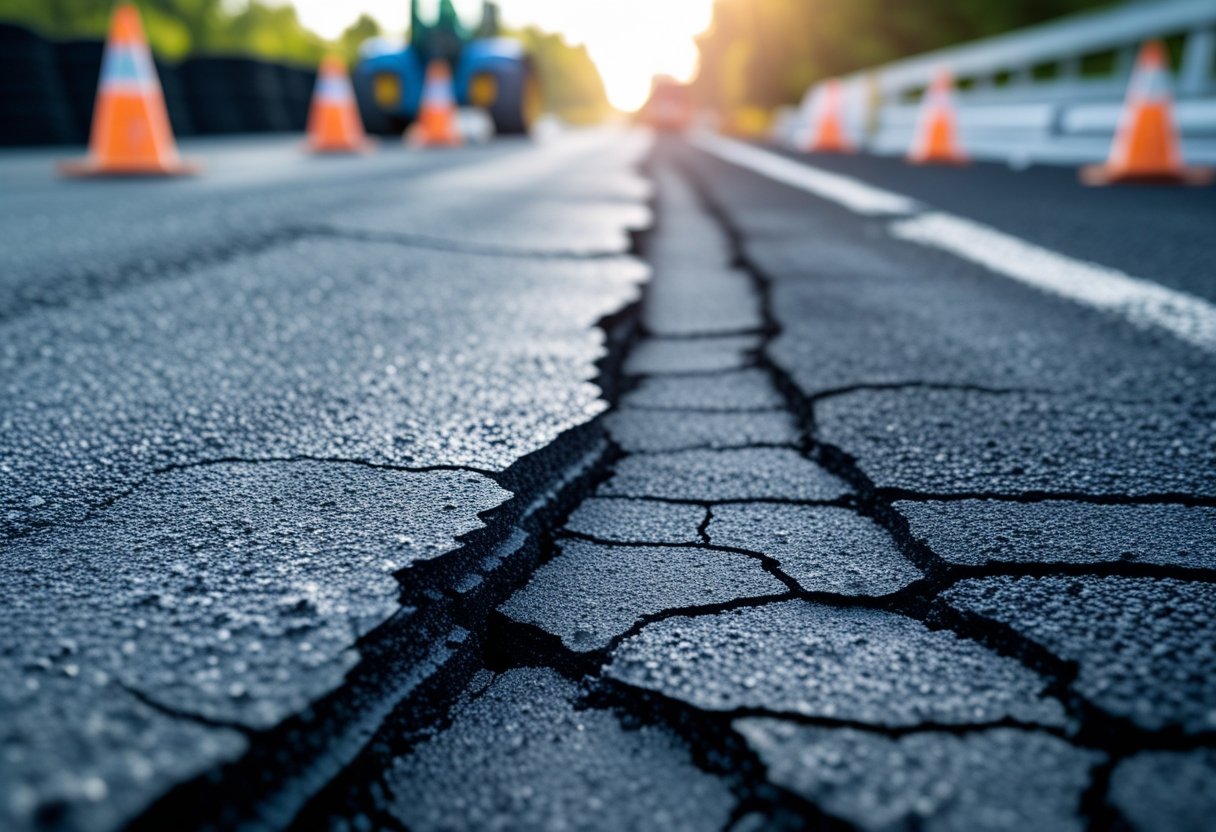
Edge cracking forms where traffic stress, material choices, and climate combine to weaken the surface and near-surface layers. We must look at how load patterns, mixture makeup, and environmental aging each drive crack initiation and growth.
Traffic Loading and Pavement Use
Traffic loading concentrates stress near the pavement edge, especially where lane widths, shoulder drop-offs, or parked vehicles change wheel paths. Repeated axle loads create tensile strains at the base of the surface layer. We see cracking grow faster under heavy truck volumes and high single-axle loads.
Poor support at the edge amplifies the problem. If the shoulder is weak or the edge is unsupported, rutting and edge deflection increase tensile strain in the asphalt concrete and hot mix asphalt surface. Turning movements and braking add shear forces that propagate cracks.
Pavement use patterns matter. Narrow lanes, frequent bus stops, or slow-moving trucks keep load over the same edge location. We monitor traffic loading and adjust design thickness or add reinforcement where concentrated wheel loads are expected.
Material Properties and Layer Composition
Asphalt mixture type controls resistance to edge cracking. Modified asphalt mixtures and polymer-modified binders improve flexibility and strain tolerance. High-reclaimed asphalt pavement (RAP) content can stiffen the mixture and raise cracking risk unless rejuvenators or softer binders are used.
Air void content and compaction level change durability. Higher air voids let moisture and oxygen enter, accelerating aging and reducing fatigue life. The surface layer must bond well to the layer beneath; weak interfaces let cracks develop at the layer combination rather than inside one homogeneous mix.
Layer thickness and gradation affect strain distribution. Thicker surface layers or well-graded mixes spread loads and lower tensile strain at the edge. We design mixes with adequate binder content and consider using modified asphalt mixtures when traffic loading or low-temperature cracking risk is high.
Environmental Impacts and Pavement Aging
Low temperatures cause asphalt to stiffen and lose ductility, raising the chance of low-temperature cracking at the pavement edge. Freeze-thaw cycles drive moisture into the surface and sublayers, expanding and contracting the structure and widening existing cracks.
Sunlight and oxygen oxidize the binder over time. Oxidation increases stiffness and reduces the mixture’s ability to relax stresses from traffic loading. Surface layers with high air voids age faster; RAP in the mix can already contain oxidized binder that speeds the process unless treated.
Drainage and shoulder condition influence moisture exposure. Poor drainage keeps water at the edge, weakening the base and increasing deflection under loads. We control environmental effects by specifying durable binders, limiting air voids, and ensuring proper drainage to slow aging and reduce edge cracking.
Evaluation and Testing Methods for Edge Cracking
We focus on methods that find crack risks, measure resistance, and link lab results to field performance. Tests include simple visual checks, instrumented field surveys, and lab fracture tests that quantify crack initiation and propagation.
Visual and Field Assessment Techniques
We perform visual surveys on wheelpath edges, shoulder seams, and longitudinal joints to locate edge cracks early. We record crack length, width, density, and nearby distresses on standardized forms or with mobile apps.
We use sketch maps and GPS-tagged photos to map cracks over time. Routine inspections after seasonal temperature swings help reveal thermal-related edge cracking.
We measure pavement deflection near the crack using falling-weight deflectometer spots or handheld deflectometers to infer load transfer loss. We may add cores at representative locations to check layer thickness, binder content, and interface condition.
We combine visual severity ratings with performance indices like crack density per square meter. This gives empirical inputs for selecting lab tests such as IDT or semi-circular bending tests.
Laboratory Crack Resistance Tests
We use Indirect Tensile Test (IDT) and tensile tests to measure tensile strength and cracking potential of asphalt mixes. IDT provides tensile strength and stress-strain behavior under controlled temperatures and loading rates. Test results help predict crack initiation under tensile loads.
We carry out semi-circular bending tests (SCB) to quantify fracture resistance and fracture energy. SCB gives a load–displacement curve that shows crack initiation and propagation phases. We record peak load, fracture energy, and instability load for comparisons across mixes.
We condition specimens for aging and moisture to simulate field conditions. We test at multiple temperatures to capture thermal cracking susceptibility. Data from IDT and SCB allow us to rank materials by crack resistance and to calibrate continuum damage mechanics models for performance prediction.
Fracture Mechanics Approaches
We apply fracture mechanics to analyze crack growth from measured fracture energy and stress intensity factors. We use SCB-derived fracture energy and load–displacement curves to compute resistance to crack propagation. This quantifies how much energy a crack needs to grow.
We model crack initiation using parameters from IDT and SCB alongside fracture mechanics criteria like critical strain energy release rate. We then simulate crack growth under cyclic loading to estimate propagation rates.
We integrate continuum damage mechanics to represent stiffness loss and cumulative damage ahead of a crack. That coupling links lab fracture resistance metrics to predicted field life and helps select mixes or treatments that slow crack initiation and propagation.
Prevention, Maintenance, and Long-Term Performance
We focus on treatments that stop small cracks, design choices that reduce edge stresses, and monitoring methods that track pavement performance over years. Practical steps target material selection, timely repairs, and measurable performance indicators.
Surface Treatments and Crack Sealing
We use crack sealing and slurry seal to protect pavement edges from water and traffic. Sealants fill cracks and prevent water from reaching the base, reducing potholes and edge break. For thin surface damage, a slurry seal restores texture and adds a protective film that delays aging.
Open-graded friction course (OGFC) can improve drainage at the edge and reduce moisture-related deterioration. We apply OGFC only where structure and traffic allow, because it can be less durable under heavy loads. Routine cleaning of sealed cracks and timely resealing every 3-7 years extends life.
We select sealant materials based on material properties like elasticity and adhesion. Polymers and hot-applied rubberized asphalt work well where reflective cracking risk is high. We document application temperature, joint preparation, and cure time to ensure consistent results.
Pavement Design and Rehabilitation Strategies
We design edges with proper cross slope and shoulder support to lower edge stresses. Full-depth patching near edges prevents reflective cracking from propagating inward. When the base shows weakness, we strengthen the shoulder or add a stabilized edge to share load.
For resurfacing, we assess whether an overlay will cause reflective cracking. Interlayers or geotextiles placed between old and new layers reduce reflective cracking risk. We match material properties; stiffness, roughness, and thermal expansion; so overlays move more like the existing pavement.
Rehabilitation choices include mill-and-fill for shallow distress, partial-depth repairs for localized damage, and full-depth reclamation when the base fails. We consider life-cycle costs and long-term performance when deciding between short fixes and structural rehabilitation.
Assessing Pavement Performance Over Time
We track pavement performance using regular visual surveys, rutting and roughness measurements, and crack mapping. Performance indicators include cracking extent, ride quality (IRI), and water infiltration rates. We log data yearly or after major weather events.
We use nondestructive testing and cores to check material properties and layer thickness. That data tells us whether an open-graded friction course or a dense overlay will perform better. We also calculate remaining service life and schedule maintenance to avoid rapid deterioration.
We compare pre- and post-treatment conditions to measure success against targets like reduced crack growth and improved ride. This helps us refine material choices and sealing intervals to maximize long-term performance.