
You notice asphalt pavement crack, rut, or soften after big swings in temperature. We explain how those changes in temperature stress asphalt concrete pavement and cause common pavement distress. You can spot early warning signs and use practical detection methods to slow or prevent serious damage.
We will show the basic physics of temperature swings on asphalt, the main distress types they trigger, and how current and new detection tools – including AI – help monitor and diagnose problems. Follow along to learn what to look for, how to detect issues, and which methods work best for different conditions.
Fundamentals of Temperature Swings and Asphalt Distress
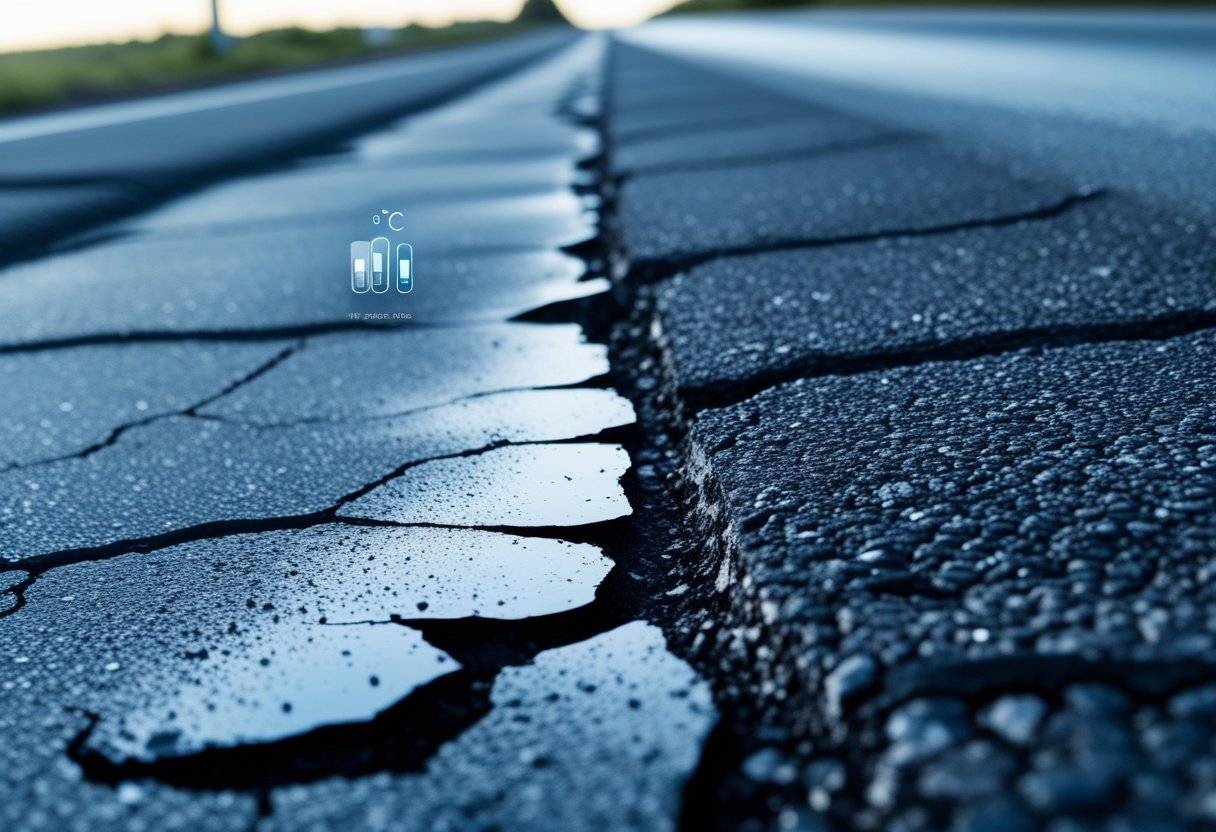
We explain how changing temperatures affect asphalt and which physical traits matter most. The focus is on how heat and cold change internal temperature, moisture, and the asphalt layer to cause cracking, rutting, and fatigue.
Mechanisms of Temperature-Induced Distress
We see distress when asphalt expands and contracts faster than it can relax. Rapid heating raises internal temperature in the asphalt layer, lowering binder stiffness and allowing rutting under traffic. Rapid cooling increases stiffness and tensile stress, which can cause thermal cracking when the material can’t redistribute stress.
Moisture content amplifies the problem. Water trapped in or under the asphalt freezes, expands, and breaks adhesive bonds. Repeated freeze-thaw cycles increase microcracking and let heat penetrate deeper, changing thermal characteristics over time. Mechanical loads applied during high temperature periods worsen deformation.
Types of Temperature Fluctuations Relevant to Asphalt
Diurnal swings (day/night) often cause surface rutting by softening the top layers during hot afternoons. Seasonal changes produce larger shifts in internal temperature through the asphalt layer, driving long-term fatigue and reflective cracking. Rapid cold snaps cause thermal shock and immediate low-temperature cracking.
Spatial temperature differences within the pavement thickness matter too. Surface temperatures respond quickly to sunlight, while internal temperature lags, creating internal gradients and shear. We must also consider extreme high temperature events that raise binder temperatures above design limits, and multi-day freeze-thaw cycles that increase moisture-driven damage.
Key Material Properties Impacted by Temperature Swings
Binder stiffness and viscosity change with temperature; high temperature reduces stiffness and raises rutting risk, low temperature increases stiffness and raises cracking risk. Thermal expansion coefficient controls how much dimensional change we see in the asphalt layer per degree of temperature change.
Thermal conductivity and heat capacity determine how fast internal temperature follows surface swings. Mixture properties-aggregate gradation, air voids, and moisture content-affect these thermal characteristics and the mixture’s ability to drain and resist freeze-thaw damage. We monitor internal temperature and moisture content because those variables predict when distress thresholds for rutting or cracking will be reached.
Main Distress Types Triggered by Temperature Swings
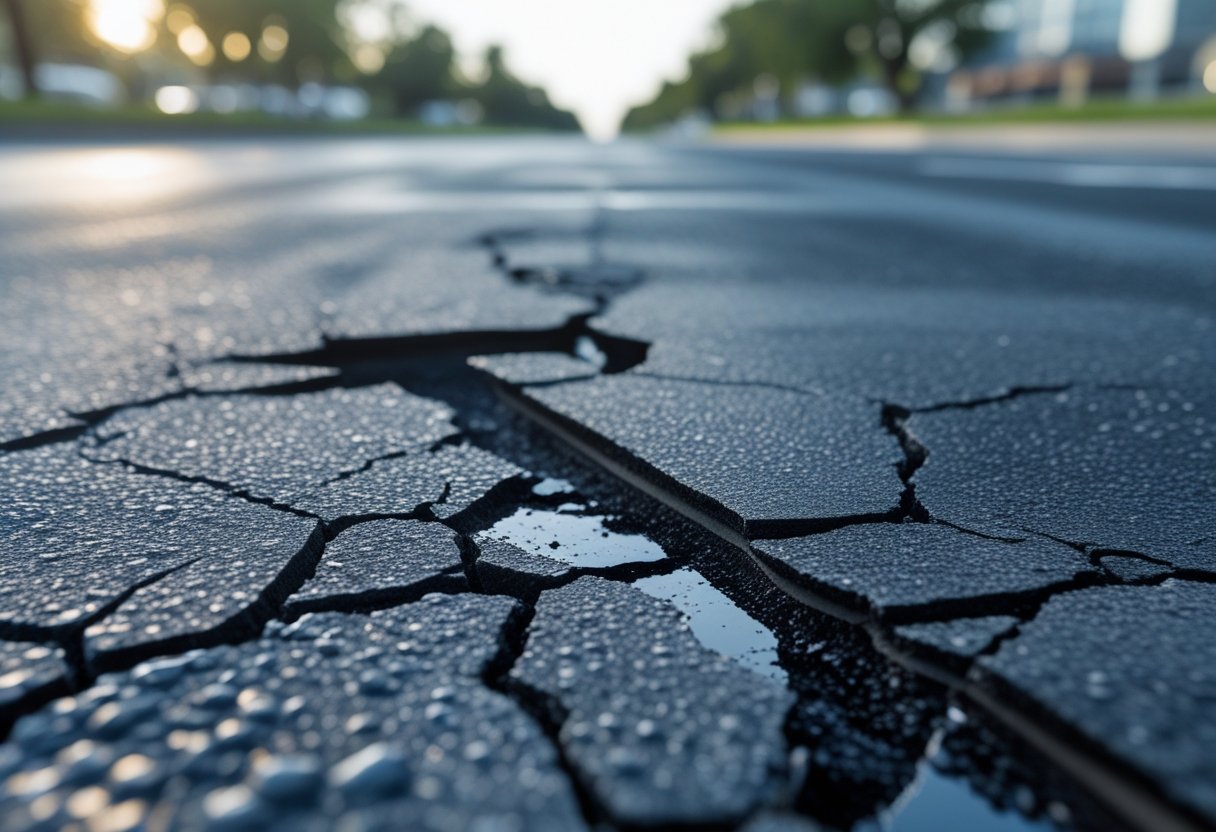
Temperature swings change asphalt stiffness and binder viscosity, which alters load distribution and moisture movement. These shifts drive rutting depths to grow, surface and subsurface cracks to form, and potholes to initiate from weakened zones.
Rutting and Rutting Deformation
We see rutting when repeated loads compress the asphalt or deform the underlying layers as the binder softens in heat. Rutting depth increases fastest during warm seasons when binder viscosity drops and aggregates shift, producing longitudinal depressions along wheel paths.
Rutting can come from plastic flow in the asphalt layer or densification and shear in the base/subbase. Warm daytime highs cause flow; cold nights slow recovery, so ruts accumulate over time. Heavy truck traffic, high temperatures, and thin asphalt lifts raise the rutting risk.
We monitor rutting by measuring depth, width, and location along the lane. Depth trends over time help us separate thermal-induced plastic flow from structural failures. Controlling mix stiffness and layer thickness reduces rut progression.
Surface and Subsurface Cracks
Thermal contraction in cold spells and expansion in heat produce tensile stresses that open surface cracks. Transverse cracking appears perpendicular to traffic from repeated thermal cycles. Longitudinal cracking follows wheel paths where tensile strains concentrate. Edge cracking develops near shoulders where support is weaker and thermal movement is larger.
Fatigue cracking occurs when repeated bending at intermediate depths causes interconnected surface cracking. Crack depth often extends from surface cracks down into binders and base layers, creating subsurface cracks that undermine structural capacity. Surface cracking lets water enter, accelerating deeper cracking and material loss.
We inspect crack patterns and measure crack depth to determine severity. Early sealing stops moisture entry and limits propagation. Targeted repairs focused on affected depths prevent small cracks from becoming widespread fatigue networks.
Pothole Formation
Potholes start where surface and subsurface cracks let water penetrate and freeze-thaw cycles widen voids. Temperature swings cause repeated expansion and contraction of trapped water, breaking bond between aggregate and binder and loosening material. Traffic then scours the weakened area into a pothole.
We watch for locations where rutting and deep cracking coincide; these spots drain poorly and fill with water, making potholes more likely. Crack depth and connected subsurface voids predict how fast a pothole will form. Repair timing matters: fixing deep cracks and improving drainage prevents pothole initiation.
Detection Methods for Distress Caused by Temperature Swings
We focus on tools that reveal temperature-related distress, how we process those images, and how we choose between manual and automated inspections. Each method links to practical steps for data collection, analysis, and reporting.
Infrared Thermography and Thermal Imaging
We use infrared thermography (IRT) to map surface temperature differences that signal subsurface voids, moisture, or thermal cracking. Portable IRT cameras, fixed cameras on masts, and UAV-mounted thermal imagers collect infrared images across lanes during times of strong temperature gradients (early morning or after sunlight changes).
Accurate results depend on sensor resolution, calibration, and emissivity settings. We record ambient conditions-air temperature, wind, solar radiation-because they affect thermal contrast.
We often fuse thermal and visible images to locate defects better. Fusion images combine the spatial detail of visible images with the thermal contrast of infrared, improving defect localization for follow-up inspection or repair planning.
Image Processing and Computer Vision Approaches
We preprocess infrared and visible images to remove noise, correct for nonuniformity, and align fused images. Common image processing techniques include histogram equalization, median filtering, and contrast stretching for thermal frames.
For crack detection and rut mapping, we apply edge detection, morphological operations, and segmentation on visible and fusion images. Real-time image processing runs on edge devices or in the cloud for quick flagging.
We evaluate methods using metrics like precision, recall, F1 score, and intersection-over-union (IoU). We store labeled datasets with PCI and pavement condition index scores to train and benchmark algorithms against ground-truth manual surveys.
Machine Learning and Deep Learning Applications
We train convolutional neural networks (CNNs) on annotated infrared, visible, and fusion datasets to classify and localize distress types linked to temperature swings. Transfer learning from large visible-image models speeds training when thermal datasets are small.
We use object detection (e.g., YOLO, Faster R-CNN) to output bounding boxes for thermal anomalies and semantic segmentation (e.g., U-Net, DeepLab) to map crack networks and delamination. We validate models using cross-validation and holdout sets, and report evaluation metrics alongside PCI correlations.
Model deployment includes on-vehicle inference for continuous monitoring and cloud-based pipelines for periodic re-training with new UAV and ground-collected data.
Manual Versus Automated Inspection Techniques
We combine manual inspection and automated systems to balance accuracy and cost. Manual inspection remains essential for validating ambiguous thermal anomalies and for hands-on measurements during limited surveys.
Automated inspection with UAV-mounted thermal cameras and onboard processing scales coverage and reduces person-hours. Automation excels at routine scanning, flagging candidate defects, and generating datasets for machine learning.
We implement workflows where automated systems produce candidate maps and severity scores, then inspectors confirm and assign PCI ratings. This hybrid approach improves consistency and helps build labeled datasets for future automation.
Advancements in AI for Accurate Distress Detection
We focus on concrete AI tools and methods that improve detection accuracy, reduce false positives, and enable usable outputs like crack segmentation, severity scores, and location maps. Below we describe key model families, training tricks, and how we test and deploy systems in the field.
Convolutional Neural Networks and Object Detection
We use convolutional neural networks (CNNs) as the backbone for most image-based pavement tasks. Models such as YOLOv3 and YOLOv5 give real-time object detection for potholes and large distress, while deep CNNs and DNNs support fine-grained classification of crack types.
Semantic segmentation networks (U-Net, DeepLab) and specialized crack segmentation models extract pixel-level masks for multiple-type distress detection. That helps compute area, length, and severity metrics. We balance accuracy and memory usage by pruning, quantization, or using lighter backbones (MobileNet, EfficientNet).
We combine object detection and segmentation: detectors find candidate regions, and segmentation refines edges. For mixed tasks, we output both class labels and severity scores via small regression heads. We cross-check with classical features like SIFT when texture helps distinguish surface noise from real cracks.
Transfer Learning and Data Augmentation
We apply transfer learning from large image datasets to reduce data needs. Fine-tuning pretrained CNNs speeds convergence and improves generalization on pavement images. That is especially helpful when labeling diverse distress types and severity levels.
We augment images with brightness, rotation, blur, and temperature-simulated color shifts to mimic thermal swings that affect asphalt appearance. GANs and synthetic image generation expand rare distress samples. GAN-augmented sets improve classifier balance and give better crack severity classification for low-frequency classes.
We also use mixup and cut-paste of crack masks to create varied contexts. These methods reduce overfitting and improve robustness across sensors and lighting. Transfer learning plus augmentation is our standard when building production prediction models.
Interpretability, Model Evaluation, and Practical Deployment
We measure model performance with mAP for object detection, IoU for segmentation, and RMSE or MAE for severity regression. We also track per-class accuracy for distress types and confusion matrices to find common mislabels. Memory usage and inference time get logged for each hardware target.
For explainability, we use Eigen-CAM and SHAP (Shapley Additive Explanations) to show which image areas drive predictions. That helps engineers trust outputs and debug edge cases like glare or oil stains. We validate models on held-out road sections and with cross-seasonal data to catch temperature-swing artifacts.
For deployment, we containerize models and provide lightweight edge versions using pruning and quantization. We integrate outputs into GIS layers and produce CSV reports with coordinates, severity, and confidence. We combine AI outputs with classical ML (random forest, gradient boosting, SVM) when sensor fusion or tabular features improve final regression or clustering tasks for maintenance prioritization.